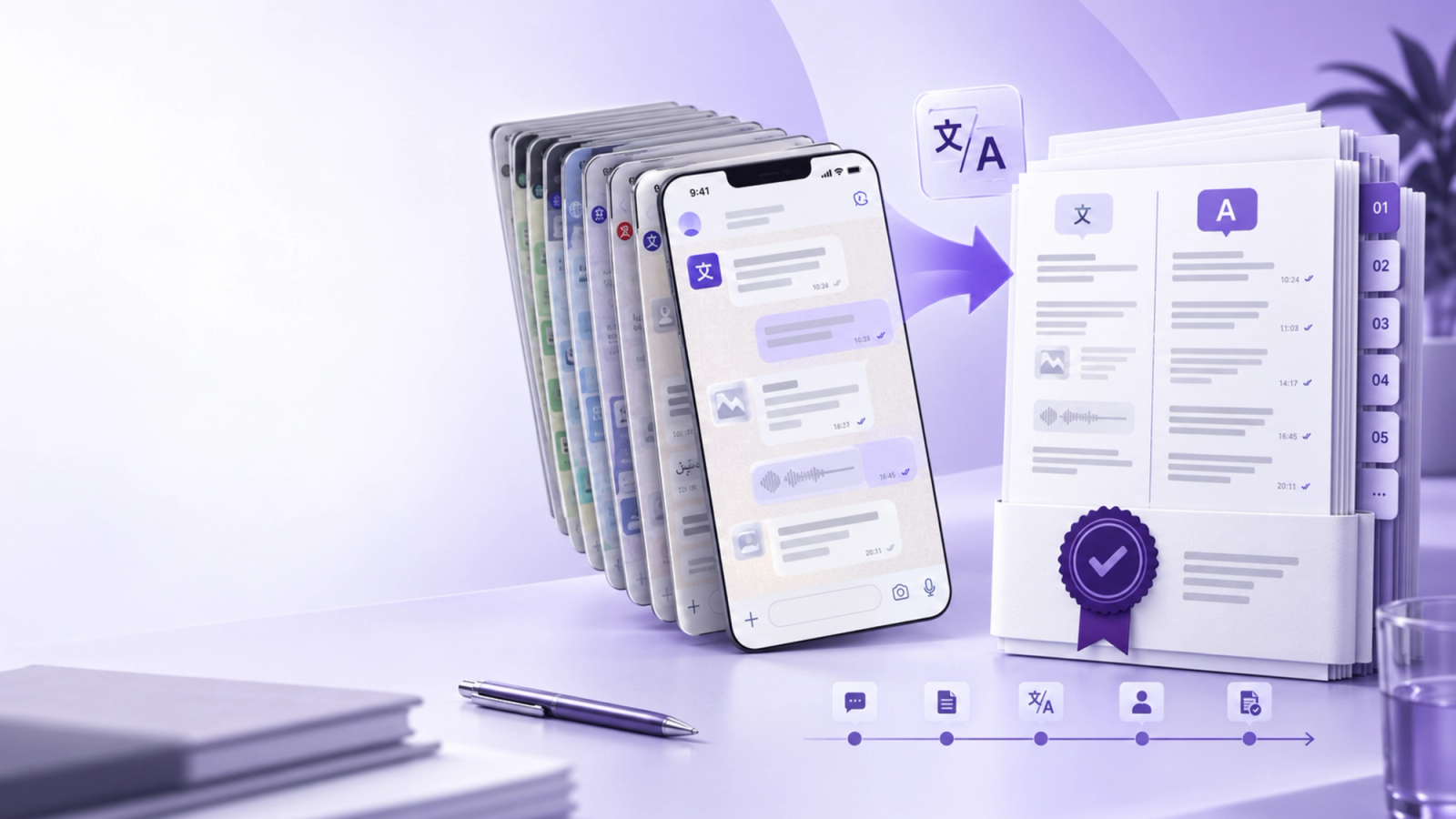
A long WhatsApp conversation can become 100 pages of screenshots surprisingly quickly.
If a translation provider charges $19.99 per page, translating those 100 pages would cost 100 pages × $19.99 = $1,999.
For families and immigration firms managing extensive conversation records, that price can feel like a penalty for preserving a detailed history.
But page count is only one way to price a translation project. A case-scope service may evaluate the complete record — including its language, condition, formatting requirements and requested turnaround — and provide one defined project price.
For example, a qualifying BonaFile case-scope project may be priced at $499, subject to confirmation of the record's language, volume, complexity, attachments, delivery requirements and current service terms.
| Pricing approach | Illustrative cost for 100 pages |
|---|---|
| Per-page service at $19.99 | $1,999 |
| Qualifying BonaFile case scope | $499 |
| Illustrative difference | $1,500 |
This does not mean every 100-page project qualifies for the same price. It also does not mean that every translation provider includes the same work.
Before comparing prices, confirm exactly what will be delivered.
Why WhatsApp records become expensive so quickly
A single civil document — such as a birth certificate — may fit neatly on one page. Conversation records are different.
One WhatsApp conversation can include:
- Hundreds or thousands of individual messages
- Multiple screenshots covering the same date range
- Repeated names, navigation bars and timestamps
- Messages written in more than one language
- Voice notes, photographs, videos and attachments
- Deleted-message notices and forwarded messages
- Reactions, emojis and stickers
- Overlapping screenshots and duplicate files
- Cropped or partially unreadable content
- Gaps caused by missing screenshots
- Different date and time formats
A screenshot may contain only a few lines of conversation. If the service charges for every uploaded image as a separate page, a long relationship record can become expensive even when each page contains relatively little text.
This is why people should compare more than the advertised page rate. The better question is: what will it cost to turn the complete source record into a clear, accurate and reviewable English-language exhibit?
What USCIS requires for foreign-language documents
Under federal regulations, a foreign-language document submitted to USCIS must be accompanied by a full English translation. The translator must certify that the translation is complete and accurate and that they are competent to translate from the foreign language into English.
This matters for two reasons.
First, a short summary of a foreign-language document is not necessarily the same as a full translation.
Second, the certification comes from the translator. The regulation does not establish a special government credential called a "USCIS-certified translator".
Applicants should also follow the instructions for the specific form they are filing. USCIS advises filers to review form-specific requirements carefully and generally not to submit original documents unless the instructions or USCIS specifically request them.
What a full translation means for WhatsApp messages
Traditional documents usually have an obvious beginning and end. Chat evidence may cover months or years and exist across hundreds of individual files.
The applicant or legal team first determines which conversations are relevant to the filing. That is a legal and evidentiary decision — not a decision the translation provider should make independently.
Once a conversation or selected record is designated for submission, the production team should handle the foreign-language content consistently and avoid silently omitting inconvenient or difficult material.
Depending on the source files, the translation may need to preserve or address participant names, message text, dates and timestamps, speaker order, image captions, system-generated notices, relevant reactions and emojis, code-switching between languages, colloquial expressions, regional dialect, typographical errors, unreadable or cropped text, voice-note transcriptions, and text appearing inside attached images.
If content cannot be read, the translation should say so rather than inventing language. If a phrase has no exact English equivalent, the translator may need to preserve the original meaning through a careful contextual translation or an appropriate translator's note.
Translation is only one part of the project
A collection of translated sentences is not automatically a well-prepared exhibit. Large conversation records often require an evidence-production process that connects the source material to a readable final package.
- 01
Source inventory
Production team
The files received are identified by format, language and any obvious gaps or duplicates.
- 02
Record organisation
Production team
Screenshots or exported messages are arranged in a logical order, usually by date and time where that information is available.
- 03
Duplicate review
Production team
Overlapping screenshots and repeated files are identified so the same content is not processed several times. The untouched source record is still preserved.
- 04
Speaker identification
Production team
The exhibit makes clear who is speaking, based on what is visible in the source. Where a participant cannot be identified reliably, nobody guesses.
- 05
Translation and human review
A model drafts, a person reviews
The selected material is translated and reviewed for accuracy, consistency, names, dates, terminology and formatting.
- 06
Bilingual alignment
Production team
Source content and English translation are placed in a consistent format so reviewers can compare them.
- 07
Exhibit assembly
Production team
Pages are numbered and grouped into labelled sections according to the project scope and the legal team's instructions.
- 08
Translator certification
A person, by signature
The package includes a signed certification addressing competence and the completeness and accuracy of the translation.
- 09
Quality assurance
Production team
Checks for missing translations, inconsistent names, sequencing problems, duplicated content, formatting errors and certification issues.
- 10
Source traceability
Built in
The package makes it possible to trace translated content back to the corresponding source material.
Per-page pricing against case-scope pricing
Neither model is automatically right for every project.
| Pricing model | Often suitable for | Potential concern |
|---|---|---|
| Per page | Short, standardised documents with predictable formatting | Screenshot-heavy records can produce a high price based on image count |
| Per word | Editable documents with easily measurable text | Hard to estimate when records contain screenshots, handwriting or attachments |
| Hourly | Unusual records requiring research or reconstruction | Final cost may be difficult to predict |
| Case scope | Large chat records requiring translation and organisation | Scope limits and exclusions must be defined clearly |
However, “flat price” should never mean “undefined service”. The provider should explain what the quoted scope includes.
How to compare two quotes fairly
A $499 quote and a $1,999 quote are not comparable unless both cover the same deliverables. Before selecting a service, ask each provider:
Is the price based on uploaded files, source pages or final translated pages? These measurements can produce very different totals.
Is the complete selected content being translated? Confirm whether the provider translates all visible foreign-language content or only selected message text.
Is human review included? Ask whether a qualified person reviews the final translation for accuracy and consistency.
Is a signed translator certification included? Do not assume certification is included simply because a service is marketed for immigration documents.
Are names, dates and timestamps preserved? These details can be important to the readability and chronology of conversation evidence.
Are duplicate screenshots identified? A duplicate review may prevent repeated content appearing throughout the final package.
Are voice notes and attachments included? Voice-note transcription, audio translation and text inside photographs may require separate work.
Is bilingual formatting included? Ask whether the source content and English translation will be presented together or delivered separately.
Are exhibit numbers and page numbers included? Translation and exhibit assembly may be separate services.
How many revisions are included? Confirm what counts as a correction, a client-requested change, or newly added content.
What happens if files are unreadable or incomplete? The provider should flag uncertain material rather than silently skipping or reconstructing it.
How is confidential information handled? Ask about secure transfer, storage, access and file-retention practices.
Is expedited delivery available? If a provider advertises a rapid turnaround, confirm it applies to the actual language, file count and complexity of your project.
How to prepare your record
Good preparation reduces delays and prevents avoidable questions.
Preserve the original files. Keep an untouched copy of the original export, screenshots and attachments. If you create a working folder with renamed files, do not replace the original archive.
Use a clear date range. Say whether the record covers a particular month, year or relationship period.
Avoid excessive cropping. Do not remove participant names, dates or timestamps unless necessary for privacy and approved by your legal team.
Identify the languages. Name every language and dialect that may appear. Many conversations switch between languages without warning.
Include related attachments. If a message refers to a photograph, audio file or document, provide it when it is part of the selected record.
Flag known gaps. If messages or dates are missing, identify the gap rather than trying to recreate content.
Provide readable files. Submit high-resolution screenshots or complete exports where possible. Blurry images create uncertainty and increase review time.
Explain the intended deliverable. Say whether you need translation only, a bilingual exhibit, a chronology, source mapping, certification, or a complete production package.
Share the real deadline. The filing deadline and the date your attorney needs the files may not be the same. Give the earlier one.
A more useful workflow for immigration firms
For a firm, the real cost of a large record is not limited to the translation invoice. Attorneys and paralegals may also spend hours renaming screenshots, sorting conversations, finding duplicates, matching translations to source files, correcting inconsistent names, rebuilding timelines, numbering exhibits, checking certifications and following up about missing content.
A structured production workflow moves that operational work away from the legal team while leaving legal judgment where it belongs. The attorney determines which evidence is relevant, what should be submitted, how the record supports the legal position, and whether more evidence is necessary. BonaFile handles the agreed production scope.
BonaFile is not a law firm and does not replace legal review.
Why this is built for records rather than pages
BonaFile is designed for evidence records, not isolated pages. The goal is to turn multilingual conversations and documents into a package that is easier for the client, the legal team and the reviewing authority to navigate.
Depending on the confirmed scope, that may include organised source files, clearly attributed conversations, preserved dates and timestamps, human-reviewed English translations, a signed translator certification, bilingual exhibits, numbered pages, chronological structure, and traceability between translations and source material.
No translation provider can guarantee that USCIS will accept evidence or approve an application. Outcomes depend on the complete filing, applicable law, the facts of the case and USCIS's review.
Get a clear scope before paying per page
If your record has reached 50, 100 or several hundred pages, do not assume the screenshot count must determine the price. Start by asking for a complete project scope. A useful quote tells you what will be translated, what will be organised, whether certification is included, how attachments and audio are handled, what the final package contains, when it will be delivered, what revisions are included, how files are protected, and what is excluded.
Sources
Questions
- How much does it cost to translate 100 WhatsApp pages for USCIS?
It depends on the pricing model and the project scope. At $19.99 per page, 100 pages would cost $1,999. A qualifying BonaFile case-scope project may be available for $499, subject to review and confirmation of the language, volume, complexity, turnaround and requested deliverables.
- Does every WhatsApp message need to be translated?
The applicant or attorney decides which records will be submitted. For foreign-language material that is included in the submission, USCIS regulations require a full English translation accompanied by the translator's certification.
A provider should not decide independently which messages are legally relevant.
- Can I submit only an English summary of the conversation?
A summary is not a substitute for the full English translation required for submitted foreign-language material. Follow the requirements of the relevant form and the advice of qualified immigration counsel.
- Can machine translation be used for USCIS evidence?
Automated translation can help with preliminary understanding, but USCIS requires the translator to certify the completeness and accuracy of the translation and their own competence.
For formal evidence the final translation should receive appropriate human review. Machine-generated wording can miss context, slang, names, code-switching and cultural meaning.
- What is a “USCIS-certified translation”?
USCIS requires a translator certification. It does not approve or certify translation companies through the rule governing foreign-language documents.
Look for a complete English translation accompanied by an appropriately signed translator certification — not an unsupported claim that a company is “USCIS approved”.
- Will a certified translation guarantee acceptance?
No. Certification addresses the translation. USCIS evaluates the complete submission, and no vendor controls that decision.
- Can WhatsApp screenshots be used as immigration evidence?
Whether particular screenshots are relevant, sufficient or appropriate is a case-specific legal question.
When screenshots are selected for submission they should be legible, consistently organised and accurately translated where necessary. Consult an immigration attorney about evidence strategy.
- Should I send original documents to USCIS?
Follow the instructions for the form being filed. USCIS generally advises applicants not to send original documents unless the form instructions or USCIS specifically request them, and may request an original during its review.
- How long does a large translation project take?
Turnaround depends on the language, the number of messages, file quality, attachments, audio content, formatting requirements and the review process. Any expedited option should be confirmed for the specific project before you rely on it.
- Does BonaFile provide legal advice?
No. BonaFile provides translation and evidence-production services. It does not determine immigration eligibility, select legal evidence, prepare legal strategy or guarantee an outcome.
This is general information about how a record is produced, not legal advice, and it is not a substitute for the advice of an attorney. BonaFile is not a law firm and does not assess cases or predict outcomes.