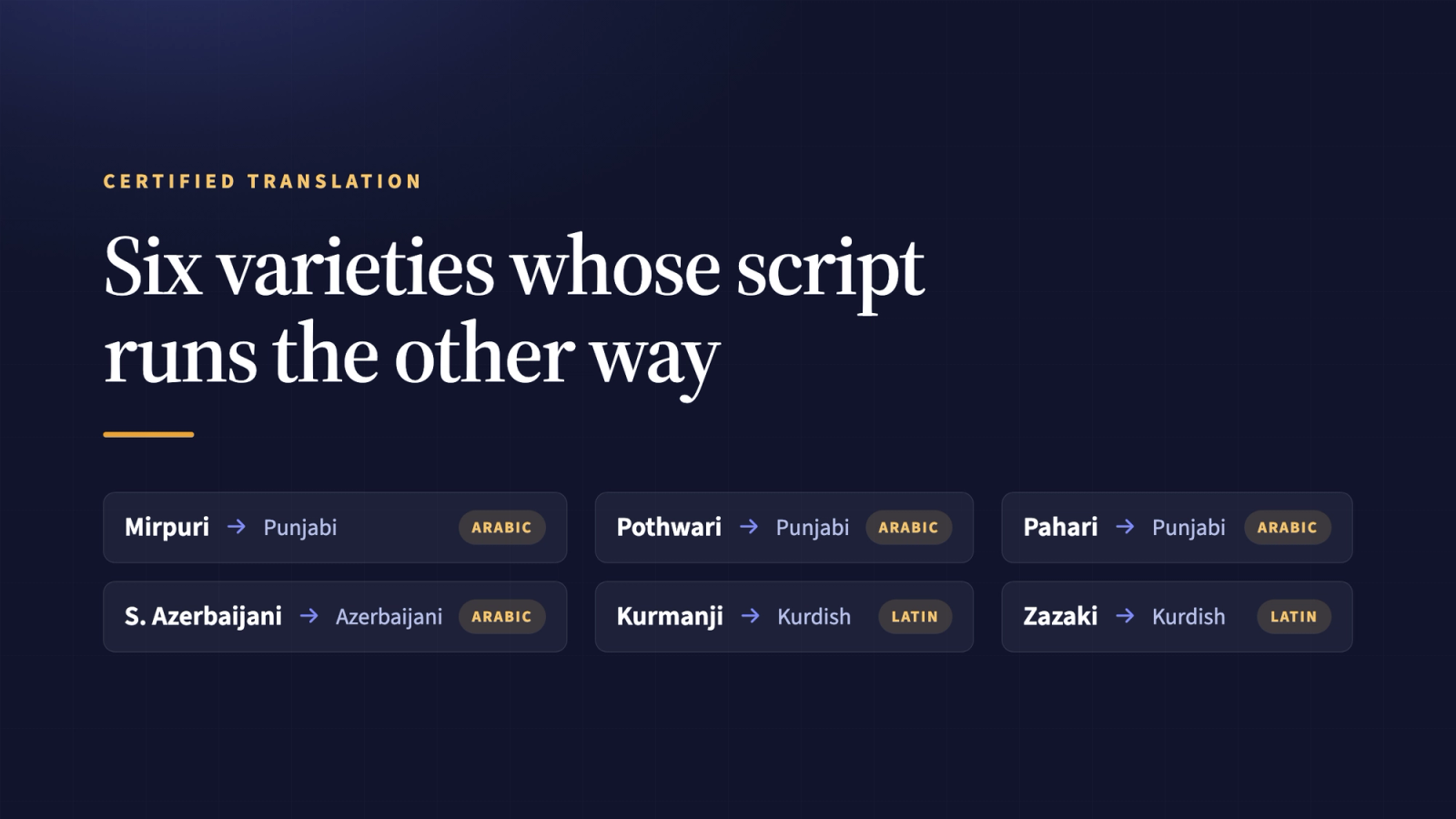
Most language lists treat a dialect as a label on its parent: Mirpuri is a kind of Punjabi, Zazaki is a kind of Kurdish, and whatever is true of the parent is assumed to be true of the child. For meaning, that is usually harmless. For a signed exhibit it is not, because two of the things a variety inherits in that model are the ones that decide how the page is built — which script it is written in, and which direction it runs.
Six of the ninety-eight regional varieties we record are written in a different script from their parent language. Every one of those six also runs in the opposite direction. A system that inherits direction from the parent gets all six backwards.
The six, and what they inherit wrongly
The pattern runs in both directions, which is why a single rule of thumb does not rescue it.
Punjabi is written in Gurmukhi and runs left to right. Mirpuri, Pothwari and Pahari — the Pahari-Pothwari group, and a very large share of the British Pakistani diaspora — are written in Arabic script and run right to left.
Kurdish is written in Arabic script and runs right to left. Kurmanji, the northern variety used in Turkey and Syria, is normally written in Latin and runs left to right. Zazaki, which is distinct from Kurmanji rather than a form of it, is also Latin and also left to right.
Azerbaijani in the Republic is Latin and runs left to right. South Azerbaijani, spoken in Iran, is written in Arabic script and runs right to left.
So "inherit the parent's direction" is wrong three times in one direction and three times in the other. There is no default that survives.
Why direction is not a formatting question
On an exhibit, direction is not styling. It is part of how the record says who spoke.
A chat exhibit is a two-column document: the original message on one side, the English on the other, in date order, with each message attributed to one of two people. The attribution is the point of the whole document — a record that shows a conversation happened but cannot say reliably who said what is not evidence of a relationship, it is evidence of a conversation.
Direction enters that at the point where the original text is placed and read. Get it wrong and the failure is not that the page looks untidy. It is that messages can be laid out and attributed against the wrong party, consistently, for the length of the exhibit. The error is invisible to anyone who does not read the script, and it is invisible to the person filing, who is often the one person in the room who does read it and is not being asked to check the English.
That is why direction is stored per variety here rather than derived from the parent language, and why the table is tested rather than trusted.
Naming the variety is the client's half of it
The practical consequence is small and worth acting on: say which variety, not just which language.
A client who says "Punjabi" when the messages are Mirpuri has given an answer that is true and not useful. A client who says "Mirpuri" has resolved the script, the direction and a set of vocabulary choices in one word. The same is true of "Kurdish" against Kurmanji or Zazaki, and of "Azerbaijani" against South Azerbaijani.
This is why the varieties are recorded under the name people actually use for their own speech rather than only under the parent language. Someone who has always called it Pothwari should not have to know that a system files it under Punjabi in order to be understood, and should not have to discover the distinction matters by finding it wrong on a document they have already signed.
Two other cases worth naming for the same reason, even though the script does not change:
- Darija means Moroccan Arabic to most people who use the word and Algerian Arabic to a fair number. Both are Arabic script and right to left, so nothing structural turns on it — but a great deal of vocabulary does. Say which country.
- Dari and Afghan Persian are the same thing, and neither is quite Iranian Persian. Arabic script and right to left in both cases.
This matters more than it first appears. If a long conversation could be summarised, a handful of misattributed messages would be diluted into a paragraph nobody checks line by line. It cannot be. The exhibit is produced message by message, however many there are, which means an attribution rule that is wrong is wrong on every line of a document that may run to thousands — and that a mistake made once at the routing stage is not softened anywhere downstream.
What we do about it
Direction is a property of the variety in our router, not a property of the parent language, and it is asserted in tests rather than assumed to have been entered correctly. The six rows above are the ones those tests exist for: they are the cases where a plausible-looking inheritance rule produces a confidently wrong document.
Across the whole set that is 167 languages, 26 writing systems and 98 regional varieties, of which 21 languages run right to left. The full table — every language, the countries it is spoken in, the varieties recorded under it, and which of them change script — is published rather than summarised, because a coverage claim that cannot be checked is a marketing number.
None of this makes a filing succeed. It removes one specific way a filing can be quietly wrong: an exhibit that reads correctly to the officer, reads correctly to the translator, and attributes the wrong half of a marriage to the wrong person.
This is general information about how a record is produced, not legal advice, and it is not a substitute for the advice of an attorney. BonaFile is not a law firm and does not assess cases or predict outcomes.