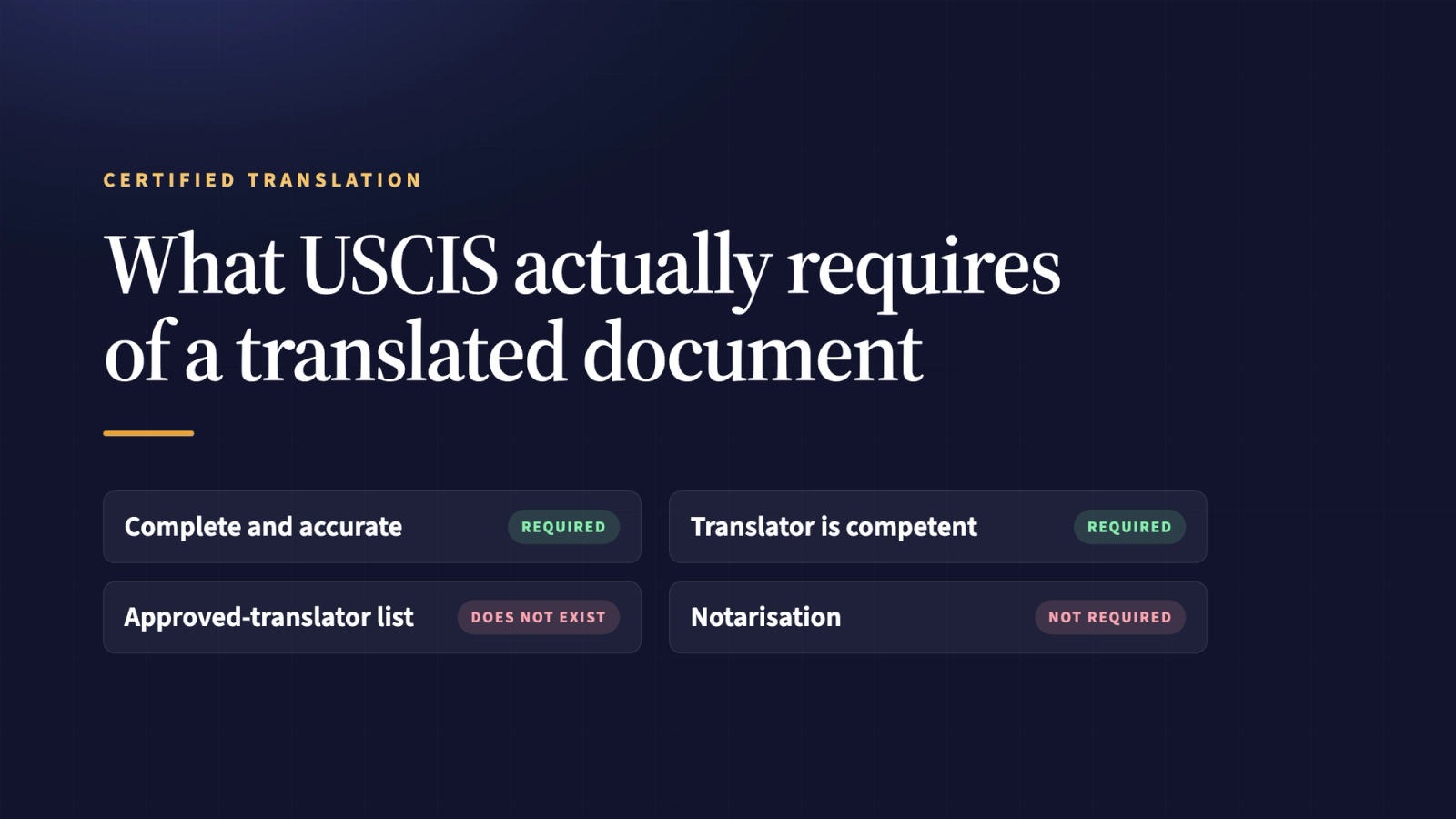
Most of what is written about USCIS translation requirements is vendor copy describing a service rather than the rule. The rule itself is short enough to read in full, and doing so is the fastest way to tell a requirement from an upsell.
The rule, in full
That is the whole of it. A certificate stating those two things, and identifying what was translated, satisfies the regulation.
Three things that are not in the rule
No approved-translator list exists. No credential is required. Notarisation is not mandated anywhere in the regulation or the Policy Manual, because notarisation attests to a signature rather than to the accuracy of a translation.
Why the page count is the problem
Agencies commonly quote fifteen to thirty dollars a page. That is survivable for a birth certificate and ruinous for four years of messages, and because a summary is not permitted, length is not something an applicant can negotiate away.
Who does the work
A certification is a statement signed by a person. Software can draft and check a translation, and ours does, but the certificate carries a human name because that is what the regulation asks for.
Nobody can promise that a filing will be accepted. What is within anyone's control is meeting the stated requirement exactly, in full, with every line traceable back to the original export.
Sources
Questions
- Does a translation for USCIS have to be notarised?
No. There is no notarisation requirement in 8 CFR 103.2(b)(3) or in the Policy Manual. Notarisation attests to a signature, not to the accuracy of a translation. It is worth having where a consulate or a court asks for it, and anyone telling you USCIS requires it is selling it to you.
- Is there an approved list of translators?
No. USCIS keeps no approved-translator list and the regulation sets no credential requirement. What is required is the translator's own certification that they are competent and that the translation is complete and accurate.
This is general information about how a record is produced, not legal advice, and it is not a substitute for the advice of an attorney. BonaFile is not a law firm and does not assess cases or predict outcomes.